Embedder

Newsletter

Embedder Launches the Arduino UNO Q Build Challenge with Arduino and Qualcomm
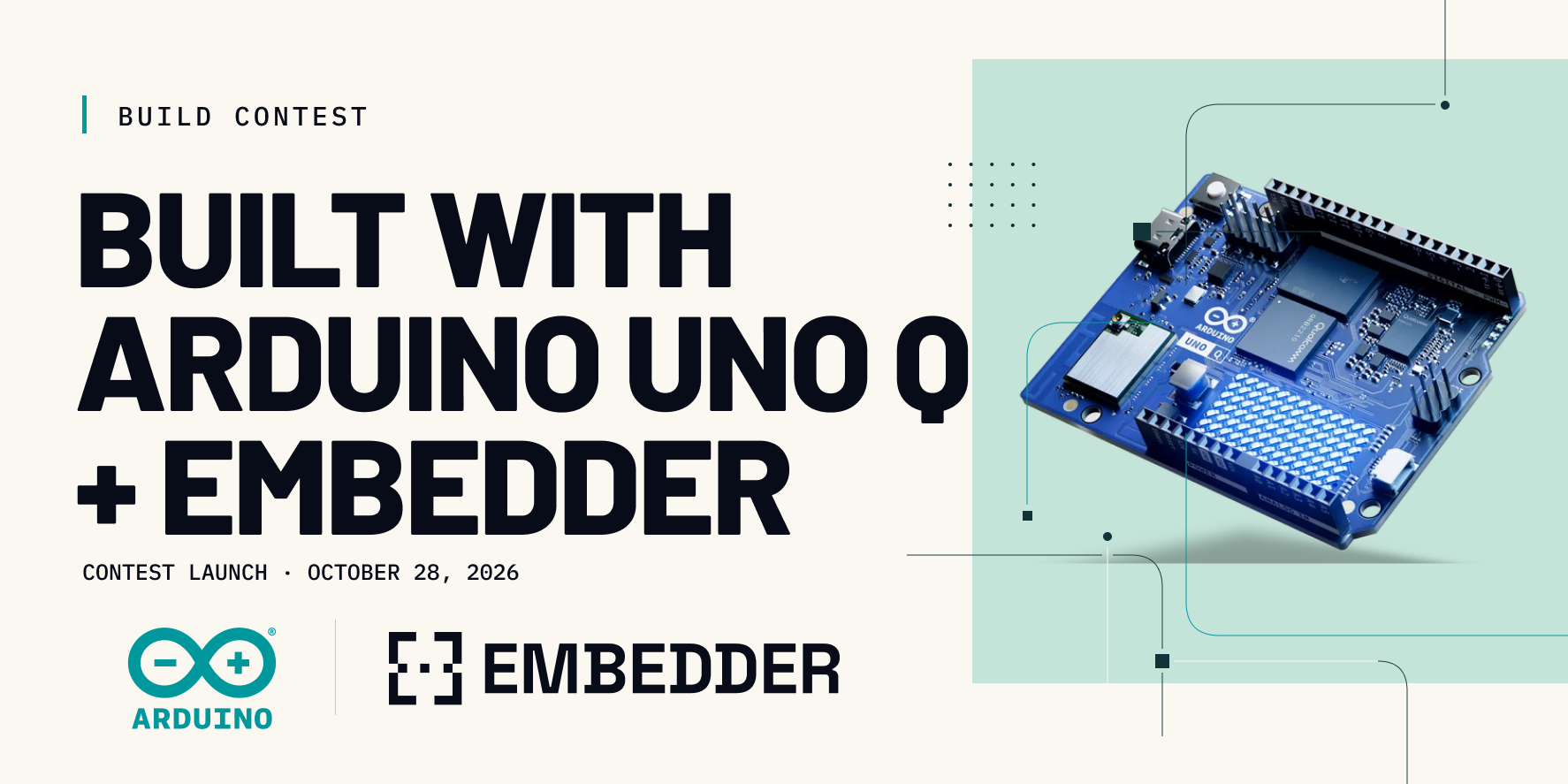
100 builders will receive an Arduino UNO Q and a full Embedder license to turn their project ideas into working hardware.

SAN FRANCISCO, Oct. 28, 2026

Embedder, an AI startup building the world's first autonomous firmware engineer, today launched the Arduino UNO Q Build Challenge with Arduino, with participation from Qualcomm. The challenge will put 100 Arduino UNO Q boards, each paired with a full Embedder license, in the hands of builders with the most promising project ideas. Submissions are open now through November 27, 2026.

Plenty of good hardware ideas never make it off the notebook page. The concept is clear, but the path from writing code to getting a board to actually do something runs through datasheets, drivers, toolchains, and long debug sessions. The challenge is designed to shorten that path, and to see what people build when they have the right board and the right tools.

A board with two brains

The Arduino UNO Q brings serious computing power to the familiar UNO form factor. It pairs a Qualcomm Dragonwing QRB2210 processor, which runs Debian Linux and handles workloads like computer vision and AI, with an STM32U585 microcontroller that runs Arduino sketches on Zephyr for real-time control. It still works with classic UNO shields and the wider Arduino ecosystem.

That combination makes room for projects that once needed several boards: a robot that recognizes objects and drives its motors with precise timing, or a sensor node that runs a model locally and reacts in milliseconds. It also means software that spans two very different environments, Linux on one side and a real-time OS on the other, working together.

Where Embedder fits

Embedder is built for exactly this kind of work. Its agent understands both your code and your hardware. It helps engineers write and change firmware, works through build and debug cycles, and connects to the target to flash builds, inspect device state, and investigate failures. For challenge participants, that means getting from first idea to working prototype faster, whether they are bringing up a new sensor, connecting the microcontroller to the Linux side, or tracking down a bug that only shows up on the device. Embedder also knows Zephyr well: the company joined the Zephyr Project in September.

"Arduino made building with hardware accessible to millions of people, and the UNO Q gives them far more to work with," said Ethan Gibbs, CEO of Embedder. "What still slows people down is the gap between writing code and getting it working on the board. We want to close that gap and see what 100 builders do once it's out of the way."

How it works

  1. Submit your idea (Oct. 28 – Nov. 27). Tell us what you'd build with the UNO Q and Embedder, what makes it interesting, and how you plan to bring it to life. Submissions close November 27, 2026 at 11:59 PM PT.
  2. Get selected (Dec. 11). Judges from Arduino, Qualcomm, and Embedder will choose 100 projects based on originality, creativity, technical feasibility, and potential impact. Each selected builder receives an Arduino UNO Q and a full Embedder license.
  3. Build it (Dec. 28 – Jan. 25). Builders have four weeks to turn their proposal into a working project. Final submissions are due January 25, 2027 at 11:59 PM PT and include a project description, source code (shared privately with the judges unless you choose to publish it), and a short demo video.
  4. Win (Feb. 8). The judges will evaluate finished projects on creativity, technical execution, innovative use of the platform, and overall quality. Winners will be announced February 8, 2027.

Already have an UNO Q? You can skip the selection round. Answer "Yes" when the submission form asks whether you own one, and you'll go straight into the build challenge with a full Embedder license. If your idea isn't selected, you can still get your own board, let us know, and compete for the top prizes.

Prizes

  • 100 selected builders receive an Arduino UNO Q and a full Embedder license.
  • Top 10 projects will be featured on Arduino and Embedder channels.
  • Top 3 projects each win an Apple Watch, plus recognition as a winning build.

What could you build?

Robotics and automation, edge AI and computer vision, smart home and IoT, and industrial projects like monitoring and predictive maintenance are all fair game. So are ideas that don't fit neatly into any category. Some of the best ones don't.

Who can enter

The challenge is open to residents of the United States, Canada, Mexico, the European Union, the United Kingdom, Switzerland, and Norway who are 18 or older (or the age of majority where they live). Employees of Arduino, Qualcomm, and Embedder and their immediate families are not eligible. Builders keep full ownership of everything they create, and can open source it or keep it private.

Full details, key dates, and the FAQ are on the challenge page. Have an idea worth building? Submit it by November 27, and share the challenge with someone who'd love it.
Embedder Joins RISC-V International as a Strategic Member

Embedder joins the organization behind the open ISA to help chip vendors, and the teams building on their silicon, get RISC-V products to market faster.

SAN FRANCISCO, Oct. 21, 2026

Embedder, an AI startup building the world's first autonomous firmware engineer, today announced that it has joined RISC-V International as a Strategic Member.

RISC-V is an open, royalty-free instruction set architecture (ISA). Instead of licensing a proprietary architecture, chipmakers can implement the RISC-V standard and extend it to fit their needs. RISC-V International, a non-profit, maintains the specifications and coordinates the global community of companies, universities, and developers that advance them. Learn more about RISC-V.

That openness is moving RISC-V out of research and into mainstream embedded products. In 2025, Infineon announced a RISC-V-based automotive microcontroller family under its AURIX brand, the first automotive RISC-V MCU family from any semiconductor supplier. Similar moves across IoT, industrial, and edge computing mean more firmware teams will be writing code for RISC-V cores in the coming years.

A new architecture brings new work for those teams. RISC-V is modular, so each chip implements its own combination of the base ISA and optional extensions, and many vendors add custom extensions on top. Interrupt controllers, startup code, linker scripts, and toolchain settings all differ from what engineers are used to on Arm Cortex-M. Debugging relies on the RISC-V debug specification rather than familiar vendor tooling. Porting an existing codebase means working through each of these details, then confirming that the result behaves correctly on hardware.

Embedder is built for this kind of work. Its agent helps engineers understand existing firmware, make code changes, and work through build and debug cycles. Through supported debug probes, Embedder connects directly to target hardware, so it can flash builds, inspect device state, and investigate runtime failures. That shortens the path from a code change to working firmware, whatever the architecture.

This matters on both sides of the RISC-V ecosystem. For chip vendors, a new RISC-V part succeeds only when customers can build on it quickly, and software and tooling are often the bottleneck. Embedder helps close that gap by making engineers productive on new silicon from day one. For device makers building on those chips, Embedder speeds up board bring-up, porting, and debugging, so teams can move to RISC-V without stalling their roadmaps. The result is faster time to market for vendors and their customers alike.

Through RISC-V International's technical and community groups, Embedder will bring the firmware developer's perspective to the ecosystem, along with hands-on insight into AI-assisted development. Embedder looks forward to working with the community to help more RISC-V products reach the market.

Embedder Launches Embedder Free, Bringing Hardware-Aware AI to Every Embedded Developer

Anyone can now use Embedder's AI platform for embedded software development on personal, educational, and non-commercial projects, at no cost. Embedder Free launches alongside Hackster.io.

SAN FRANCISCO, Oct. 14, 2026

Embedder, an AI startup building the world's first autonomous firmware engineer, today launched Embedder Free, a new plan that gives anyone access to its enterprise AI platform for embedded software development at no cost. Embedder Free is launching alongside Hackster.io, home to one of the largest communities of hardware and embedded developers.

Whether you're bringing up your first board or you've been shipping firmware for years, Embedder Free is an invitation to see what AI can do on real hardware, at your own pace.

Why we built it

General-purpose coding assistants struggle with firmware. They invent register names, call SDK functions from the wrong chip family, and have no way to check their work on a device. We documented these patterns in detail in Where LLMs go wrong in firmware.

Embedder was built to close that gap. It grounds its work in the datasheets, reference manuals, and schematics for your hardware, and it connects to your board to flash builds, inspect device state, and debug failures until the code actually runs.

We believe the next chapter of embedded development is an exciting one. Engineers get more room to think like system architects, experiment freely, and use AI to help build, test, and iterate. We want the whole embedded community to experience that shift with us, and the best way to understand it is to get hands-on.

What's included

Embedder Free is designed for individual developers exploring Embedder on their own projects. It includes:

  • Access to the Embedder agent as a single user
  • Support for select hardware platforms, schematic formats, and AI models
  • Free credits, up to a usage limit
  • Email and community support, including our Discord

Embedder Free is for personal, educational, and non-commercial projects. Start building with Embedder today.