
Overview
The prototype phase is where embedded schedules are won or lost, and the least predictable part of it is board bring-up. The silicon is proven and the product idea is sound, yet teams routinely lose two to six weeks between “the dev board arrived” and “the peripheral we care about works” — weeks that were supposed to go toward the prototype itself. That loss compounds: senior engineers burn their most expensive weeks on register maps instead of product logic, part selection locks in before anyone has validated the cheaper alternative, and testing starts after the deadline instead of before it.
Embedder closes the gap with an AI agent built for firmware rather than adapted to it. It starts from an indexed catalog of hundreds of MCUs and thousands of peripherals, ingests the datasheet and schematic for your specific board, drafts a plan with citations back to the reference manual, checks every generated value against that documentation before it reaches hardware, and validates the result against live silicon through the bench equipment you already own — from inside the IDE your team already uses. The result is drivers written against the actual part, verified on the actual board, and a working prototype in days instead of weeks.
1. Where prototype time goes
Most embedded prototypes don’t fail on the idea. They stall in the weeks between the new dev board arriving and the peripheral that matters responding.
The time disappears in ways every firmware engineer will recognize. Reading the datasheet for the eighth time. Rewriting, for a slightly different chip, a UART driver you’ve already written ten times. Hunting down the one footnote that admits GPIO 12 is open-drain only. Wrestling a vendor HAL into a project structure its example code never imagined. None of this is the interesting part of the prototype, yet all of it stands between the team and that part.
For an engineering leader, the same weeks look different and cost more. Bring-up is where the prototype schedule stops being a plan and becomes a guess: nobody can say whether the I²C bus comes up Tuesday or in three weeks, because the answer depends on which errata footnote bites first. Two engineers on bring-up for a month is a month of senior-engineer burn before the first line of the code the prototype was meant to prove.
It’s also the reason teams commit to a part early. When getting a part running is expensive, nobody can afford to do it twice, so selection closes before the cheaper candidate gets a fair look — and the BOM carries that decision from prototype to production.
2. Why general-purpose coding AI hasn’t fixed this
AI coding tools have reshaped web development, and most firmware teams have tried pointing one at an embedded project. It usually disappoints, for four reasons that have nothing to do with model quality.
The failure mode is silent. When a model hallucinates a web API call, the code fails loudly at runtime and gets patched. When it hallucinates a register offset, a bit position, or a timing value, the compiler blesses it — and the board pays. A wrong value compiles cleanly, then bricks a boot, corrupts a bus, or ships a subtle fault into the field. Nothing in a general-purpose tool’s pipeline is positioned to catch it.
They can’t touch the hardware. A web developer can ship AI-generated code, watch it break in production, and patch it an hour later. In firmware, that patch is an OTA update costing thousands, if the device can take one at all. Until code has been observed running on the target, it’s a hypothesis. A tool with no path to the board has no way to close that loop.
They spend context, and money, indiscriminately. General-purpose agents cope with unfamiliar silicon by stuffing entire SDKs and reference manuals into the context window, then billing for every failed attempt. A year ago, CEOs bragged about their AI spend on podcasts; now they’re explaining to their CFOs why one engineer burned a multiple of his salary in tokens. Brute-force context is the expensive way to not understand a chip.
They sideline the engineer. Autocomplete on register writes gives you no plan to review and no citations to check. The wrong assumption surfaces at hour three, in the debugger, instead of in a sixty-second review of a spec.
3. How Embedder gets a prototype working
Embedder’s workflow is built around one principle: ground every step in documentation, verify it against that documentation, then prove it on silicon before moving on.
3.1 Start from an indexed catalog, not a blank datasheet
Embedder maintains a catalog covering hundreds of MCUs and thousands of peripherals: reference manuals, errata sheets, application notes, and SVD device files, indexed for retrieval. When the agent needs the exact sequence for enabling a peripheral clock domain, it queries the relevant section rather than scrolling a 1,500-page PDF through the context window. Retrieval against an index costs a fraction of context stuffing, and it’s more accurate, because the agent reads the paragraph that matters instead of summarizing the chapter around it. In one internal benchmark on a customer firmware project, Embedder’s harness used 40%+ fewer output tokens than the general-purpose agent used as the comparison baseline; results vary by project and workflow.
The catalog is a head start, not a boundary. A part Embedder has never seen goes through the same ingestion pipeline — it just starts from your PDF instead of the index. There is no approved-parts list to be on.
3.2 Ingest the hardware you actually built
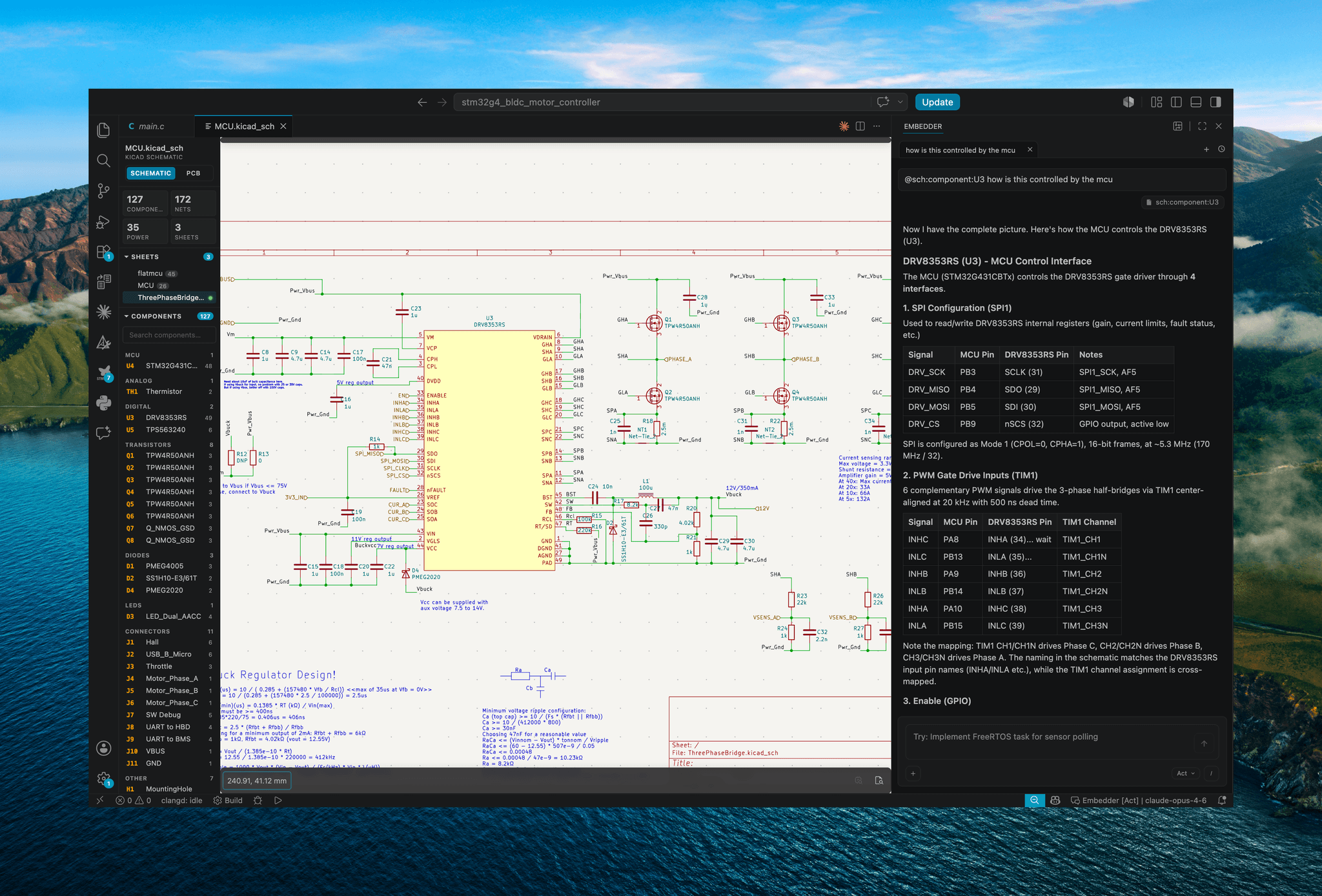
The catalog covers the silicon; your board is yours. Embedder parses your schematic directly from Altium, KiCad, Eagle, PADS, or Xpedition — pin assignments, power rails, which sensor hangs off which bus, the pull-ups you did or didn’t place. Custom components come in the same way: upload the datasheet, and validation runs against your board rather than the vendor’s reference design.
3.3 Plan first, with citations
Before writing code, the agent drafts a spec: peripherals in dependency order, register-level configuration, timing constraints, with each claim cited back to the section of the reference manual it came from. An engineer reviews and approves the plan before any code exists. A wrong assumption gets caught in sixty seconds of reading instead of sixty minutes of debugging, and the engineer stays the decision-maker, not the cleanup crew.
That control extends past the plan. Teams set policies for which operations run autonomously and which need a human first — approve every flash, every commit, or neither, depending on how much rope the project can afford.
3.4 Write drivers against the real part
With an approved plan, the agent scaffolds working drivers (UART, I²C, SPI, GPIO, ADC, PWM, BLE, Wi-Fi, cellular) written for the actual part in your project structure, not a generic template bent to fit. Initialization lands in the correct order: clock tree, power domains, peripheral enables, with the settle times the datasheet requires rather than the ones the example code happened to use.
Where the work parallelizes, it runs in parallel: specialized subagents take separate tracks — one authoring a driver, one writing its HIL tests, one validating power draw — under a single orchestrator with one audit trail. Multi-hour workflows compress into minutes.
3.5 Check before flash
Between generation and hardware sits a verification layer built for the silent-failure problem in section 2. Every generated value is checked against the evidence: register addresses against the SVD file, pin assignments against the schematic, timing against the datasheet, silicon-revision quirks against the errata. Anything the agent can’t cite gets flagged for review instead of written into the code anyway.
This is what keeps the loop fast. Catching a wrong bit position on paper costs seconds; catching it on the board costs a flash cycle and a debugging session. The board is the final verifier, not the first one.
3.6 Prove it on silicon
Every step still closes against the live board, because documentation can’t model everything: simulators don’t capture the analog front-end of your sensor, the glitchy supply on Rev B, or the timing skew on a real I²C bus. The agent flashes the target and reads the result through the integrated serial terminal, where UART output stops being something an engineer eyeballs and becomes evidence the agent acts on. Beyond the serial port, a proprietary SDK communicates with a catalog of test equipment — GDB servers, logic analyzers, oscilloscopes, power profilers, a J-Link or ST-Link, a Saleae, a PicoScope, a JouleScope — and ingests exported logs from tools without APIs.
All of it runs from VS Code, alongside the toolchain your team already uses: parallel instrument sessions, debugger, logic analyzer, scope, and power profiler at once, in the editor rather than around it. And because agents test concurrently, a suite that would eat a bench day runs overnight, with results waiting in the morning.
It does this with guardrails an engineer would insist on: destructive operations like flash erase and fuse programming require explicit confirmation, and hardware I/O is rate-limited. Your only Rev A board is treated like your only Rev A board.
As each driver lands, so do its first hardware-in-the-loop tests: does the peripheral acknowledge, does the sensor return sane data, does current draw match the datasheet. Those checks then run on every commit, which is what keeps a working board working while the prototype grows around it.
3.7 The first day, concretely
Drop the datasheet and schematic into the project and plug in the board. Embedder ingests both and drafts a plan for the peripheral you care about; you review and approve it. The agent writes the driver, verifies it against the documentation, flashes the board, and a result shows up on the serial terminal inside the hour.
From there the loop stays tight, and it doesn’t stop at bring-up: extend the driver, add the application logic the prototype exists to prove, run it, read what the board actually did, go again. The same cycle that got the first peripheral talking carries the prototype to demo-ready.
4. Case study: defense-grade RF firmware, drivers in an hour instead of days
A defense and aerospace company builds drones and systems that live or die on their radio links. Their engineers write firmware for proprietary long-range RF modules on custom radio boards, and every board revision arrives with its own device tree, clock configuration, and I²C quirks — bring-up, repeated at every spin.
With Embedder, drivers that used to take days are written in an hour. The C source stays aligned with the datasheets, device trees, makefiles, and clock and I²C configuration as each new revision lands, so a respin no longer resets the prototype. And the same loop runs in reverse when hardware misbehaves: Embedder pulls test results and raw serial logs straight off the bench, analyzes the telemetry, and writes targeted instrumentation to isolate exactly where packets are being dropped. Instrument, flash, test, read, repeat.
The outcome, as their CTO describes it: firmware that became hardware-agnostic, a development process that can start from manufacturability instead of working backward toward it, and what their CTO described as an estimated 10x acceleration in software development. That figure is the customer’s estimate, not a controlled cross-project benchmark.
5. Evaluating Embedder on your hardware
The evaluation is the product. Bring a board and its datasheet — the one that just arrived, the part nobody on the team has shipped on, the prototype with a demo date attached. Pick the peripheral that’s currently blocking you and run the first day on your own silicon: ingest, plan, approve, flash, and a result on the serial terminal inside the hour. That’s enough to know whether Embedder earns a place in your prototype.